You have decided to merchandise the eco-friendly bags range in your store. Now comes the part that determines whether customers buy them or walk past them. Design is not a finishing touch, it is the whole game.
If you have read our guide on why every retailer should merchandise eco bags, you already know the case for making bags a profit center rather than a cost center. This blog picks up from there and focuses on one thing: how to design a bag that customers actually want to buy and reuse.
A plain bag with your logo on it is still just a plain bag. Customers will not pay for it willingly, will not reuse it, and will not carry it anywhere you would want your brand to be seen. Sometimes the logo matters less than you think. What resonates with customers is often a design element, a colour, a texture, something that feels like your brand without spelling it out. Done right, the design itself becomes the brand.
The good news is that the difference between a bag that sits and a bag that sells is not about spending more. It is about making smarter design choices. Small, cost-effective decisions in colour, texture, finish, and variety are what turn a functional item into something a customer picks up at checkout because they genuinely want it.
1. Shift How You Think About the Bag
When a bag is free and handed out with a purchase, the design barely matters. Customers take it, use it once, and forget it. But when you are charging for it, the rules change completely. The customer is making a small purchase decision, and like any purchase decision, it is driven by whether the product feels worth it.
That is the mindset shift: stop designing a bag that represents your store and start designing a bag your customer wants to own. The brand can still be present, but it needs to live within a design that has its own appeal. This could be something that works as a lifestyle product first and a retail bag second.
A customer will happily pay a little more for a bag that looks good. They will not pay anything for a bag that looks like a freebie or or has something very visible on it.”
Not sure where to start? Talk to our team and we’ll help you think through the brief.
2. Cost-Effective Design Elements That Increase Perceived Value
You do not need to redesign your entire brand identity to create a bag worth selling. A few well-chosen design elements can significantly lift the perceived value of a bag and make it far more likely to sell at checkout. Here are the ones that make the biggest difference for the investment:
Contrast handles
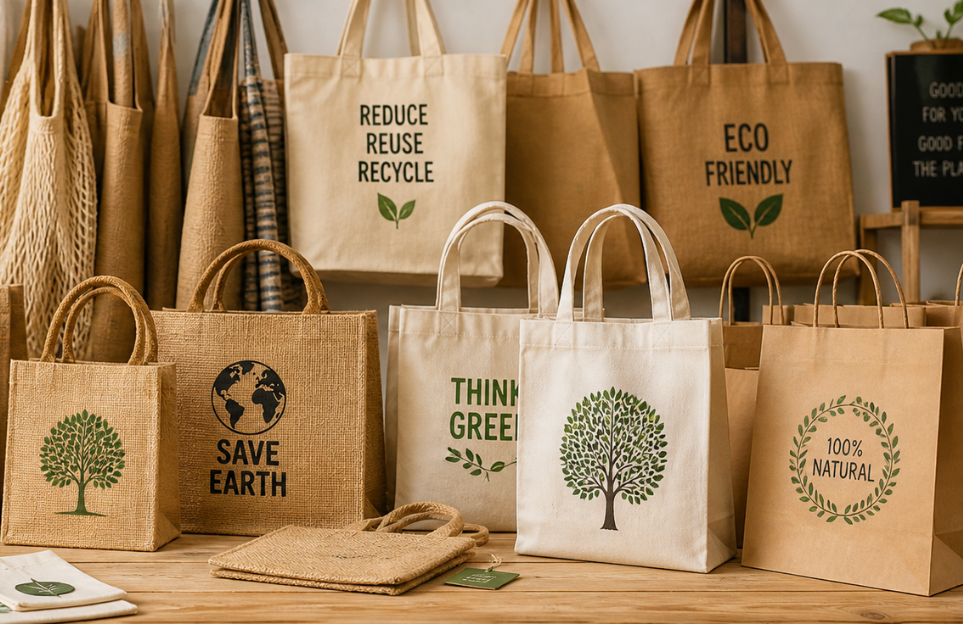
Switching the handle to a contrasting colour or material is one of the simplest ways to make a bag feel intentionally designed. It signals that someone made a considered choice, and that alone shifts perception from functional to fashionable.
Woven or printed labels
A small woven label at the seam or a printed tag inside the bag adds a quality cue that customers associate with premium products. It is a minor addition in cost but a meaningful one in feel.
Coloured base or panel
Adding a contrasting colour block to the base or a side panel breaks up a flat design and gives the bag visual structure. It looks considered without requiring complex artwork.
Typography-led design
A well-chosen phrase, a word in a strong typeface, or even a subtle pattern built from type can carry a bag’s entire visual identity. It keeps branding present but turns it into something customers actually want to read and carry.
Tonal or monochrome palette
Bags that work in a restrained, considered colour palette feel more versatile and more luxe. Customers are more likely to carry a bag that goes with everything than one that only matches their shopping day outfit.
The small detail principle
You do not need all of these on one bag. In fact, the best designs usually pick one or two of these elements and execute them well. The goal is a bag that feels like a product someone designed, not a blank canvas someone printed on.
3. Design Around Themes Your Customer Already Connects With
One of the most effective ways to make a bag feel desirable rather than generic is to design it around a theme your customers already have a relationship with. A theme gives the bag a personality beyond your brand and makes it feel like something worth owning for its own sake.
This is also where eco bag design can move well beyond what most retailers currently offer. Instead of one bag with a logo, you offer a small range of bags with distinct themes, each one appealing to a slightly different customer or mood. Here are some examples:
Nature and botanicals
Line illustrations of plants, leaves, or coastal scenes. Works across most retail categories and has broad lifestyle appeal.
City and culture
Skylines, Arabic typography, geometric patterns inspired by regional architecture. Resonates strongly with UAE residents and visitors alike.
Minimal and typographic
A single word, a short phrase, or a bold graphic mark. Clean, versatile, and easy to carry without looking overly branded.
Seasonal and limited editions
Ramadan, National Day, or seasonal collections. Creates urgency and collectability, customers buy because they know it will not always be available.
Sustainability messaging
A simple, well-worded statement about reducing waste or choosing better. Customers who are eco-conscious want to carry that message.
Brand lifestyle
Not your logo, your world. The imagery, colours, and language that represent the lifestyle your brand speaks to, without it feeling like an advert.
The key with themes is restraint. A bag does not need to tell the whole story of your brand. It needs one clear, confident idea to be executed well.
Not sure where to start? Talk to our team and we’ll help you think through the brief.
4. Always Offer More Than One Design
This is one of the most underleveraged decisions in eco bag merchandising: giving customers a choice. When there is only one bag, the customer either buys it or does not. When there are two, three, or four designs, something different happens. Customers start deciding which one they prefer. That shift from a yes/no decision to a preference decision is powerful, and it consistently improves uptake.
2 to 4 designs: The sweet spot for a retail eco bag range. Enough variety to drive choice and collectability, without overwhelming the display or complicating reorders.
Multiple designs also create the conditions for repeat purchase. A customer who buys one design in January might come back for a different one in March. Seasonal or limited-edition designs reinforce this further by creating a reason to buy before a design disappears.
When planning your range of designs, think about offering variety across:
- Colour: light and dark options, or warm and cool tones
- Theme: one design that is more graphic, one that is more typographic
- Occasion: an everyday carry option and a more expressive or seasonal one
- Customer profile: a design that appeals to a younger customer and one with broader demographic appeal
You do not need to cover all of these in one range. Two well-considered designs with clear differences between them will outperform four designs that look too similar.
5. Match Your Printing Method to Your Material
Even the best design can be let down by the wrong print method on the wrong material. Getting this right is not just a technical detail. It directly affects how the finished bag looks, feels, and holds up over time, all of which feed back into whether the customer feels it was worth what they paid.
If you are unsure which print method suits your design and material, get in touch and our team will recommend the right combination for your design.
6. Design Dos and Don’ts
To bring it all together, here is a practical summary of what consistently works and what consistently does not when designing eco bags for retail sale.
Do this
- Design for lifestyle first, brand second
- Offer 2 to 4 distinct designs with real differences between them
- Use one or two cost-effective details to lift perceived value
- Keep colour palettes restrained and versatile
- Match your print method to your material
- Consider seasonal or limited-edition designs to drive repeat purchase
- Brief your bag supplier alongside your design, not after
Avoid this
- Leading with a large, dominant logo
- Offering only one design with no variation
- Treating the bag as an afterthought to the main packaging brief
- Using too many colours or too much artwork on a single bag
- Choosing the cheapest print option regardless of material
- Designing for your brand without considering what your customer wants to carry
Key Takeaways
- A bag customers pay for needs to feel worth buying. design is what makes that happen.
- Small, cost-effective details like contrast handles, woven labels, and tonal palettes dramatically lift perceived value.
- Designing around themes gives the bag a personality beyond your brand and makes it more desirable.
- Offering 2 to 4 designs shifts customers from a yes/no decision to a preference decision, and consistently improves uptake.
- Matching your print method to your material affects quality, durability, and how premium the finished bag feels.
- Design for the customer’s lifestyle first. Your brand fits within that, it does not lead it.
Frequently Asked Questions
Does better bag design mean significantly higher production costs?
Not necessarily. Most of the design elements that increase perceived value – contrast handles, a woven label, a tonal colour palette add very little to the unit cost. The bigger impact comes from making considered choices early in the design process, not from spending more on materials.
How many designs should I launch with?
Two to four is the recommended range. Starting with two strong, distinct designs is a practical way to test customer response before expanding the range. The priority is that each design has a clear identity and real differences from the others, not just a colour swap.
Can I use the same design across different bag materials?
Sometimes, but it needs care. A design built around bold flat colours works well on non-woven but may lose its impact on textured jute. It is worth reviewing how your chosen artwork translates across materials before committing to a print run, especially if you are planning a range across multiple bag types.
How do I keep the brand present without making it the focus?
The most effective approach is to integrate brand identity into the design system rather than applying it on top. That might mean using your brand colours as the palette for a botanical print, or incorporating your brand name as one typographic element within a broader composition. The brand is there, it just does not dominate.
Ready to Design a Bag Worth Carrying?
At Bag the Future, we work with retailers across the UAE and GCC to develop eco bag ranges that customers genuinely want to buy. From material selection and print method to design themes and multi-option ranges, our team can help you get every decision right.
Get in touch to discuss your design and other requirements and we will take it from there.
Get in Touch to Discuss Your Requirements
Sources & References
- Forrester Consulting: Consumer sustainability purchasing influence, cited in global retail sustainability reports
- GCC Sustainable Packaging Market Report, 2025: Market valuation USD 469M, 8%+ annual growth
- Global Organic Textile Standard (GOTS): global-standard.org
- Forest Stewardship Council (FSC): fsc.org
