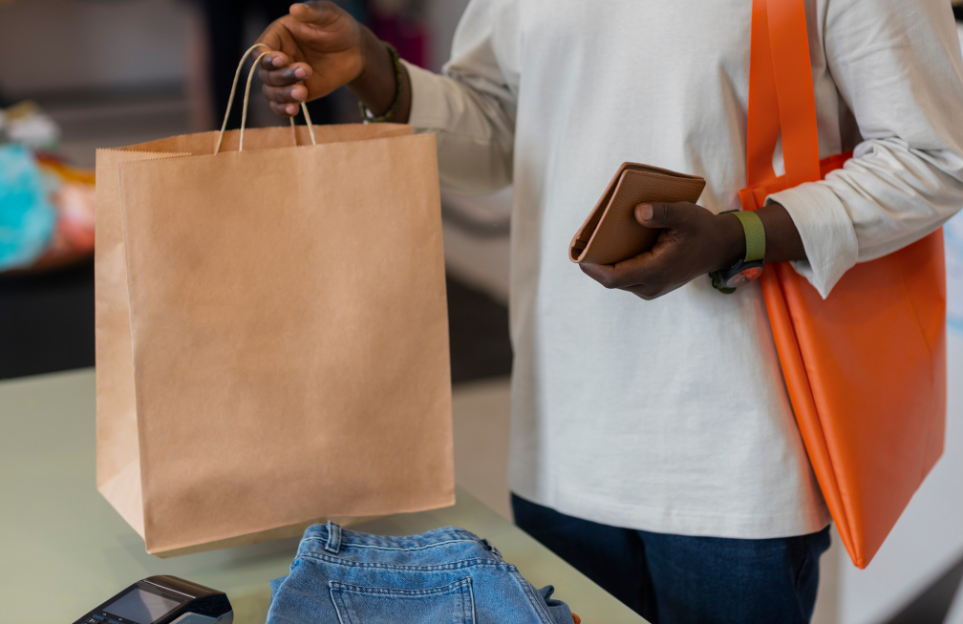
Your electronics store, fashion boutique, or pharmacy hands every customer a bag at checkout. Right now, that bag is either costing you money or being charged to the customer as a plastic or paper bag. Traditionally, shopping bags have always been a cost center. But what if your shopping bags could generate revenue and become a profit center instead?
Most retailers think about the bag last. It is ordered in bulk, it carries the logo, and it costs as little as possible. That approach is leaving serious money on the table.
The opportunity is to merchandise bags as a product in your store. Not hand them out, but to sell them. And the way you make that work is by designing a bag so good that your customer actually wants to buy it and carry it everywhere: to the mall, to the market, to the beach. A bag that becomes part of their routine. That is when the bag stops being a packaging cost and becomes a revenue line in its own right.
Supermarkets figured this out first. But there is no reason it stops there. Electronics stores, fashion boutiques, pharmacies, home goods retailers, almost every retail category in the UAE is sitting on this opportunity and has not yet taken it.
This blog explains why now is the right moment, and how to make it work for your store.
1. The Market Has Already Shifted
Dubai formally banned single-use plastic bags in January 2025, following Abu Dhabi’s 2021 ban. Sustainable packaging is now a compliance requirement for every retailer, not a premium option for only the environmentally minded brands.
But regulation is just the floor. The real opportunity sits above it.
USD 469 million
Value of the GCC paper and sustainable bags market in 2025, growing at over 8% annually. (Industry market analysis, 2025)
44%
of global consumers say a brand’s sustainability commitment directly influences their purchase decisions. (Forrester Consulting)
Retailers who move first on eco bag merchandising are not just becoming compliant. They are capturing brand real estate in their customers’ daily lives before their competitors do.
2. Why Has This Been a Supermarket Thing Until Now?
Supermarkets adopted reusable eco bag ranges early because their transaction volume: millions of bags, millions of compliance fines, and a customer base trained to expect bags at checkout. The business case was hard to ignore.
But the same maths applies to every retailer. The volume may be smaller, but the logic is identical: you are already paying for a bag at every transaction. The only question is whether that bag works for you or against you.
Most retailers offering eco-friendly bags are simply ticking the compliance box. Very few have thought about making it intentional or merchandising it actively.
The shift happening now is that mid-market and independent retailers in fashion, electronics, beauty, home goods, and pharmacy are realising what supermarkets already know: a well-designed reusable bag is not a packaging cost. It is a product.
3. The Win-Win Case: Revenue, Brand, and Sustainability at Once
Eco bag merchandising works because it solves three problems simultaneously, and each one pays for the others.
1. It generates direct revenue
A quality reusable bag sold at checkout for 5 to 15 AED is a product your customer chooses to buy. That revenue offsets what you previously spent on single-use bags and quickly turns a sunk cost into a margin line.
2. It builds brand outside your four walls
A quality reusable bag can be used hundreds of times over its lifetime; cotton totes are built to last 50 to 150+ uses. If the bag is designed well, every time a customer carries your bag through a mall, a market, or a beach, your brand is subtly visible to people who have never set foot in your store. Every single one of those trips is a brand impression, at zero additional cost to you.
3. It gives customers a genuine choice to go eco-friendly
Customers increasingly want to shop with brands that reflect their values. Offering a well-designed reusable bag at checkout is a simple, low-friction way to signal that your brand is aligned with theirs, and 44% of consumers say this directly influences where they spend.
4. Which Retailers Should Be Doing This?
The short answer is: all of them. Here is what eco bag merchandising looks like across different retail categories, and which bag types work best for each:
Fashion, Boutique & Designers
A beautifully designed cotton or canvas tote becomes part of the purchase experience and customers carry it as a lifestyle accessory.
Cotton bags, canvas bags, juco bags
Electronics Retail
Structured non-woven or RPET bags handle heavier purchases and project a clean, tech-forward brand image.
PP Non-woven bags, PP woven bags, Recycle PET bag
Pharmacy & Health
Clean, minimal cotton or non-woven bags with subtle branding convey trust and care, values that already drive pharmacy loyalty.
Cotton bags, canvas bags, PP non-woven bag
Home Goods & Lifestyle
Jute or Juco bags match the natural, considered aesthetic most home and lifestyle brands already project.
Jute bags, Juco bags, Recycle PET bag
Beauty & Cosmetics
A premium cotton drawstring or branded tote elevates the gifting moment and extends the unboxing experience beyond the store.
Cotton tote bags, canvas bags, drawstring bags
Not sure which bag type suits your store?
Get in touch with our team and we will make a recommendation based on your category, brand, and budget. 303vip
5. Design Makes or Breaks It: Lifestyle Over Logo
The most important thing to understand about eco bag merchandising is that the bag has to be something your customer wants to carry, not just something they received at checkout. A bag dominated by a large logo reads as a promotional freebie. A bag designed as a lifestyle product gets carried to malls, beaches, and markets for months.
The key principle: subtle brand identity integrated into the design consistently outperforms heavy logo placement for reuse rates. And more reuse means more brand impressions, at no additional cost.
Read this blog where we’ve covered bag design in detail in a dedicated guide. Contact us to discuss your design and other requirements and our team will walk you through the options.
Key Takeaways
- Dubai’s plastic bag ban is live. Every UAE retailer needs a compliant bag solution now.
- Eco bag merchandising turns a compliance cost into a revenue line and a brand asset.
- Every retail category benefits, not just supermarkets.
- Subtle lifestyle design dramatically outperforms heavy logo branding for reuse rates.
- The right bag type depends on your category: cotton for fashion, non-woven for electronics, jute for lifestyle brands.
- Bag the Future works with retailers at every scale and within MOQs for independent stores.
Frequently Asked Questions
Why should a fashion or electronics retailer sell bags? Isn’t that a supermarket thing?
Supermarkets were early adopters, but the logic applies equally to every retailer. You are already paying for a bag at every transaction. A well-designed reusable bag sold at checkout generates direct revenue, replaces that cost, and puts your brand in front of new audiences every time a customer carries it.
How much should I charge for a branded eco bag at checkout?
Most retailers price reusable bags between AED 3 and 15 depending on material, design and some other factors. At that price point, customers who want to go eco-friendly are happy to pay, and the revenue comfortably offsets your unit cost.
Why does design matter so much? Can I just put my logo on a bag?
You can, but a bag dominated by a large logo reads as a promotional item. Customers associate it with something received for free, not something they would choose to carry. Lifestyle-forward design with subtle branding gets the bag carried to malls, beaches, and markets, generating far more impressions over its lifetime.
Does Bag the Future work with smaller independent retailers, or only large chains?
Both. We work with retailers at every scale, from national chains to single-location boutiques. We offer flexible MOQs so independent retailers can get started without committing to large volumes. Contact us to discuss what works for your store.
Ready to Launch Eco Bags for Your Store?
At Bag the Future, we help retailers of all sizes across the UAE and GCC design, manufacture, and deliver customised eco bags that generate revenue, build brand, and give your customers a genuine sustainable choice.
Whether you need jute bags wholesale in Dubai, custom cotton bags for your boutique, or just want to explore what is possible for your store, get in touch and we will take it from there.
Get in Touch to Discuss Your Requirements
Sources & References
- Dubai Municipality — Single-use plastic bag ban, January 2025
- UAE Ministry of Climate Change and Environment — Ministerial Resolution No. 380 of 2022
- Forrester Consulting — Consumer sustainability purchasing influence, cited in global retail sustainability reports
- GCC Sustainable Packaging Market Report, 2025 — Market valuation USD 469M, 8%+ annual growth
