
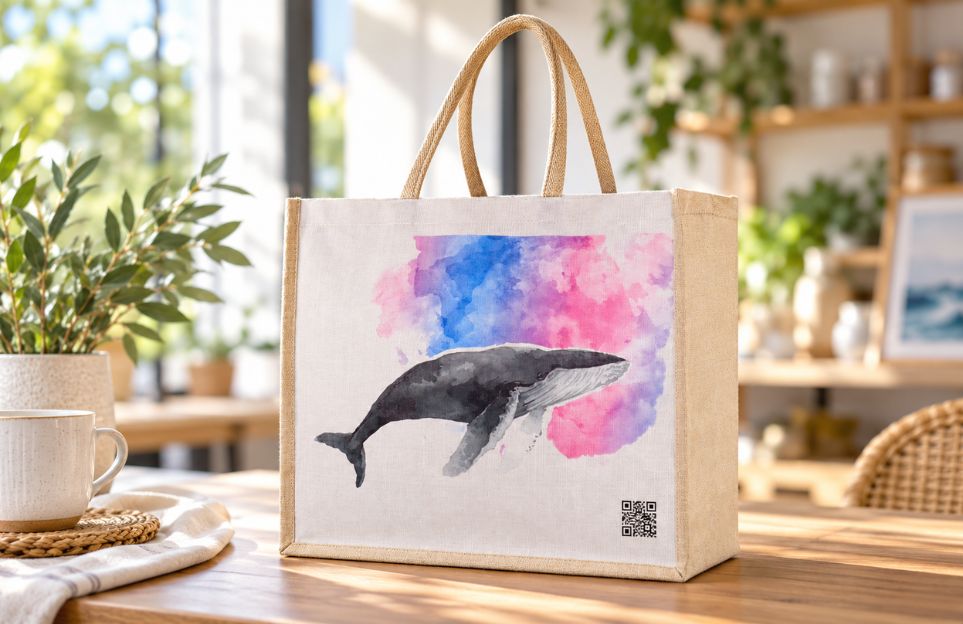
How to turn a branded bag into a channel you can actually report on.
Here is a question worth sitting with for a moment.
Why did physical marketing lose its budget to digital?
The usual answer is that digital works better. It targets precisely, it optimises in real time, it reaches people where they already are. All true, and none of it is the actual reason.
The actual reason is that digital could be counted. For fifteen years, every marketing team has been asked the same question in every budget review, which is what did we get for that. Digital had a dashboard. Print, out-of-home, sponsorship and merchandise had a shrug and a brand tracker.
Budgets do not follow effectiveness. They follow evidence.
Which is why the most interesting thing about a branded bag is not the bag. It is the two centimetres of printed code on the side of it.
This is the fifth post in our carry media series. The first made the business case, the second applied it to product launches, the third to retail, and the fourth to banking campaigns. Each of those raised the same objection at some point, which is how you measure any of it. This post is the answer.
1. A Code Turns Physical Media Into a Tracked Channel
Put a code on a bag and you get scan volume, timestamps, approximate location and device. Tag the destination and it flows into analytics like any other source, through to sign-up or purchase.
The interesting number is none of those. It is the shape of the curve. Every paid campaign produces the same graph: activity rises when the budget starts and falls off a cliff when it stops. A bag produces a long thin tail instead, because the asset is still in circulation.
Events make the gap obvious. GITEX Global draws over 200,000 attendees from 180 countries. An exhibitor measures three days of badge scans, then closes the report. The bags handed out at that stand go home in suitcases and keep working for years.
Thinking about putting a code on your next run? Talk to our team.
2. Static or Dynamic: the Decision Most People Make by Accident
A static QR code has the destination encoded into the pattern itself, so it points there permanently. A dynamic code encodes a short redirect you can repoint at any time. On a poster coming down in four weeks that barely matters. On an object built to last two years it is the difference between an asset and a liability.
| Static code | Dynamic code | |
| Destination | Fixed at print, permanently | Changeable at any time |
| If the page is retired | Every bag leads to a 404 | Repoint it in a minute |
| Campaign reuse | One campaign only | Reassign to the next |
| Right for | Short-life print | Anything that outlives the campaign |
The failure mode is common. A brand prints twenty thousand bags with a static code pointing at a campaign page; the campaign ends, somebody deletes the page, and every bag now demonstrates that the brand does not have its house in order.
3. Where to Point It
Not the homepage, because somebody made a physical effort to reach you, and a generic landing wastes that intent. Not a campaign page with an end date either.
Point it at something with a standing reason to exist. A WhatsApp Business number, a rewards enrolment, a demo booking page. At a conference, a code opening the live agenda gets scanned repeatedly by far more people than a sales page, and every scan is attributable to your bag.
The test: would anyone scan this twice?
4. Printing a Code Onto Fabric
A code that fails to scan is worse than no code, because it fails in public. Four things cause almost every failure. Size, because the weave softens each module’s edge. The quiet zone, because designers crop the clear space or push the code against a seam. Contrast, because low-contrast codes on busy patterns read poorly. And placement, because a code across a fold curve exactly when the bag is full.
Material helps. RPET felt is needle-punched into a dense, smooth surface that holds a crisp edge, and canvas can be laminated from the inside to keep the printed panel flat. Where scan reliability matters, specify a laminated surface and test a sample at real size.
Key Takeaways
- Physical marketing lost budget to digital because digital could be counted, not because it worked better.
- Scan data gives volume, timing, location, and attribution. The long tail is what paid channels cannot match.
- Use a dynamic code on anything that outlives its campaign.
- Scan failures come from size, a cropped quiet zone, weak contrast or placement across a fold.
Frequently Asked Questions
Do people actually scan QR codes on bags?
They scan when there is a clear reason to. A bare code gets ignored, while a code with one line explaining what happens next performs very differently. The code costs almost nothing to add, and the alternative is no measurement at all.
Should you use a static or dynamic QR code?
Dynamic, for anything printed on a reusable item. A static code locks the destination permanently, so when the landing page is retired, every bag becomes a broken link. Dynamic codes cost a small subscription and let you repoint the whole run at any time.
How do you track leads from a QR code?
Add UTM parameters to the destination URL, so scans arrive in analytics as a named source rather than direct traffic. Give separate bag designs, separate codes, and measure cost per scan and cost per lead rather than cost per bag.
How big should a QR code be on a tote bag?
Larger than the same code on paper, because the weave softens the printed edges. Rather than work to a fixed figure, print a test sample at the intended size on the actual material and scan it. Leave clear space on all four sides.
The carry media series
|
Ready to Put a Code on Your Next Run?
At Bag The Future we make customised eco bags for technology, telecom and events brands across the Middle East. If a code is going on the bag, tell us at briefing stage rather than artwork stage. Explore RPET, canvas, or get in touch.
Sources
- Dubai Exhibition Centre, GITEX Global 2026 event listing. Attendance and country figures.