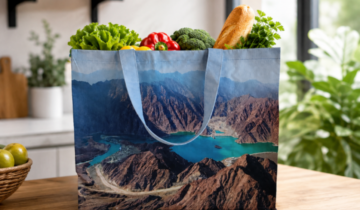

A brand in Dubai launches a new product. The plan looks familiar. A three-week paid social burst, a creator seeding round, some display, a launch-day push.
The campaign runs. The numbers come in. Impressions look healthy.
Four weeks later the budget is spent, the ads have stopped, and if you stopped ten of the people who saw them and asked what launched, most could not tell you.
That is not a media buying failure. That is what rented attention does. You pay for a window and the window closes.
Meanwhile, every order that brand shipped went out in a bag. Every pop-up handed one over. Every launch-day guest carried one home. Nobody counted any of it as media.
This is the second post in our carry media series. The first made the business case for treating a reusable branded bag as an advertising format rather than as packaging. This one is about the moment where that matters most.
1. Launch Budgets Have a Structural Problem
The problem is not creative, and it is not targeting. It is duration.
A launch concentrates almost all of its spend into a short window, and every format inside that window stops on the day the flight ends. Paid social stops. Display stops. The creator post drops down the feed. What you bought was a burst of attention, timed to the launch, expiring immediately after it.
Awareness does not build in a burst, though. It builds through repetition over time, which is precisely the thing a launch budget cannot afford to buy.
A branded bag inverts that. You pay once, at launch, and the impressions accumulate afterwards, for as long as the customer keeps using it.
2. What a Launch Bag Does That an Ad Cannot
It goes home
An ad reaches the customer where you targeted them. A bag travels with them, to a different neighbourhood, a different building, a different social circle. It markets in places you never bought.
It is chosen, not served
Nobody chooses to see an ad. A customer who packs your bag for a grocery run is making a small public decision to be associated with your brand. That signal reads very differently to the people around them than a paid placement does.
It cannot be blocked, skipped or scrolled past
No ad blocker, no skip button, no fatigue curve, no bidding against your own retargeting.
It keeps working after the campaign closes
This is the one that matters for a launch. The paid window ends on schedule. The bag does not.
3. Four Places a Launch Bag Earns Its Cost
The delivery bag
For ecommerce and quick commerce, this is the highest-leverage placement in the business, because it is the one physical moment you already own with every single customer. A branded reusable shopping bag that arrives with the order becomes the customer’s shopping bag next week, which is when your brand goes back out in public.
The order was going out in something regardless. The only real decision is whether that something keeps working for you afterwards.
Pop-ups and retail activations
Launch activations produce a spike in foot traffic and almost nothing that leaves the venue. The bag is the thing visitors carry out. It extends a two-day activation into months of visibility across the city.
Launch-day gifting and PR kits
Press, partners, and creators receive a lot of boxes. Most of the box is thrown away within the hour. The bag is the component that survives, and the component that reappears in a photo three months later, unprompted.
Event and community seeding
Anywhere your launch audience already gathers, whether a market, a conference or a member’s event, a well-made bag turns attendees into distribution. Drawstring bags and backpacks and sling bags work well here, because people wear them on the day rather than carrying them home in a tote.
Planning a launch and want to work out where the bag fits? Talk to our team.
4. Choosing the Right Bag for a Launch
Four options cover most launch scenarios.
| Material | Why it suits a launch | Best used for |
| R-PET felt | Made from 100% recycled plastic bottles and GRS certified. Soft but structured, with a premium feel. Takes print, dye and embroidery. | PR kits, launch gifting, premium pop-ups |
| R-PET woven and canvas | Recycled polyester with the sturdiness and look of a classic tote. Prints cleanly. | Retail totes, merchandise, creator seeding |
| PP woven | Woven polypropylene tapes give the highest strength of the four. | Bulk deliveries, grocery, heavy goods |
| PP non-woven | The most economical reusable option, with the production capacity for large volume runs. | Large-volume seeding, event giveaways, delivery inserts |
Two practical notes.
If print is doing the heavy lifting, meaning a bold launch identity, full-colour artwork or a pattern, laminated PP non-woven applies a BOPP film that lifts print sharpness and surface durability considerably. It is the cost-effective route to making a launch design look expensive at volume.
If the recycled-content story is part of the launch narrative, R-PET is the one that arrives with documentation. GRS certification means the claim survives scrutiny rather than inviting it. We covered how the material is made in Introducing R-PET Bags Made From Recycled Plastic Bottles.
5. Designing a Launch Bag People Actually Keep
Most launch merchandise fails the same test. It is designed as an announcement, so it stops being usable the moment the announcement is old.
That matters more than it sounds. The UK Environment Agency life cycle assessment of carrier bags found that a non-woven polypropylene bag should be reused at least 11 times to have a lower global warming potential than a lightweight plastic carrier bag that is not reused. Your commercial break-even works the same way. A bag used once returns almost nothing, on either measure.
Three rules keep a launch bag in circulation.
Do not date it
Printing “Launching March 2026” guarantees the bag becomes obsolete on a fixed schedule. The entire point is longevity. Leave the date off.
Design it, do not brand it
A bag dominated by a logo reads as promotional and gets used once. A bag with a considered design, where the brand is present as one element rather than the whole thing, gets carried. Your logo does not need to be the largest object on the bag in order to be seen. We go into this properly in How to Design Eco Bags That Actually Sell.
Make it worth the reuse
Weight, stitching, handle strength, base construction. A bag that fails on the second grocery run produces no impressions. What it produces is an impression of your brand quality, which is considerably worse than nothing.
6. What to Measure
The objection to carry media is always measurement. It is answerable.
- Print a QR code. Point it at the launch landing page, an offer, or a WhatsApp sign-up. Scans are a hard number, and unlike an ad, they keep arriving weeks after the campaign has ended. We go deeper into this later in the series.
- Use a launch-specific code. A discount or referral code that appears only on the bag isolates exactly what the bag drove.
- Track reuse, not just distribution. Distribution is a cost number. Reuse is the return. Ask about it in post-purchase surveys.
- Watch the organic photos. Bags turn up in customer and creator content without being asked. That is earned media you did not brief or pay for.
Key Takeaways
- Launch budgets fail on duration, not creativity. Paid formats stop the day the flight ends, while awareness needs the repetition a launch window cannot fund.
- The delivery bag is the highest-leverage placement most ecommerce brands already own and do not use.
- Pop-ups, PR kits and event seeding each produce a physical moment where a bag can extend the campaign past its end date.
- R-PET suits premium positioning and recycled content narratives. PP woven and PP non-woven suit strength and volume. Laminated non-woven is the cost-effective route to high-impact print.
- Leave the launch date off, design the bag rather than brand it, and make it good enough to survive well past the second use. Everything depends on it being reused.
- QR codes and bag-specific discount codes make the channel measurable.
Frequently Asked Questions
How many bags should we order for a launch?
It depends on where they are going. A delivery insert programme is sized against your order volume across the launch period, while a PR and creator seeding round might be a few hundred. Quantities and minimums vary by material and finish, so get in touch and we can size it against your plan.
Is a bag not just a giveaway? How is this a media buy?
The difference is whether it leaves the venue and keeps being used. A giveaway is consumed once. A reusable bag delivers impressions in public for as long as it stays in circulation, which is why it belongs in the media conversation rather than the merchandise one.
How far ahead of launch do we need to order?
Earlier than most teams expect. Custom production, printing, sampling and approvals all take time, and launch dates move. Bring the bag into the plan when you brief the campaign, not when you brief the packaging.
Should the bag match the launch campaign artwork?
Partly. Keep the palette and identity, so it reads as part of the launch, but avoids campaign-specific copy and dates. The campaign has an end date. The bag should outlive it.
For ecommerce delivery, is R-PET or PP non-woven the better choice?
PP non-woven is the more economical option at high volume and prints well in its laminated form. R-PET carries the recycled-content credentials and a more premium feel. If the launch is about sustainability positioning, choose R-PET. If it is about maximum reach per dirham, choose PP non-woven.
In this series
Read the first post: The Marketing Tool That Pays You Back, and the Planet Too. The business case, the cost-per-impression maths, and how to get it approved internally.
Coming next: Retail and FMCG. What happens to your in-store branding investment the moment the customer walks out of the door.
Related reading:
Ready to Plan the Bag Into Your Next Launch?
At Bag The Future we make customised eco bags for ecommerce, retail and corporate brands across the UAE, Saudi Arabia, Qatar, Kuwait, Bahrain, Oman and the wider Middle East. Every bag is fully custom, with size, print, finish, and material chosen against what the campaign actually needs to do.
Tell us what you are launching and when, and we will help you work out the right bag, the right volume and the right lead time.
Get in touch to discuss your requirements
Sources and references
- UK Environment Agency (2011), Life Cycle Assessment of Supermarket Carrier Bags, report SC030148. Source of the 11-use figure for non-woven polypropylene.
- Textile Exchange, holder of the Global Recycled Standard (GRS). Certification reference for R-PET.